
Quick Answer
To get a surety bond in India, you typically apply through an IRDAI-licensed broker or insurer with your company, project and financial documents. The insurer then underwrites the application, reviews the required documents and may seek clarifications. Once the terms are agreed and the required documentation and premium are completed, the bond is executed and issued for submission to the project owner.
Start Point
"Where do I actually get one?" "Am I even eligible?" "What documents will they ask for?" "How long does this take?" — these are the questions we hear on almost every call, usually from a contractor who's just been told a Surety Bond is an option for their Performance Security and has no idea what happens next.
If you'd like to understand what a Surety Bond actually is first — the bond types and how it compares with a Bank Guarantee — see our Surety Bonds Explained. This blog focuses purely on the application journey: who's eligible, what actually happens step by step, what you're signing, and where contractors most often lose time.
One thing worth remembering from the outset: a surety bond isn't something you simply order off a price list. Underwriting is involved in every application, much like a bank assessing a credit facility.
Who Can Apply for a Surety Bond?
Yes — surety bonds are open to contractors of most sizes, not just the largest EPC players, provided the application meets underwriting requirements. We regularly arrange surety bonds for civil contractors, infrastructure developers, turnkey contractors, construction companies, engineering firms and MSMEs — whether the project sits with NHAI, a central government body, a state government body, a PSU, or is sourced through GeM.
Eligibility comes down to underwriting, not company size. What matters to an insurer is a healthy balance sheet, relevant delivery experience and realistic execution capacity — not just turnover. A well-run MSME with a clean track record can find it easier to get a bond approved than a larger contractor juggling stretched commitments. Every application is assessed on its own merits; approval is never automatic and is subject to the insurer's eligibility criteria and the tender's own conditions.
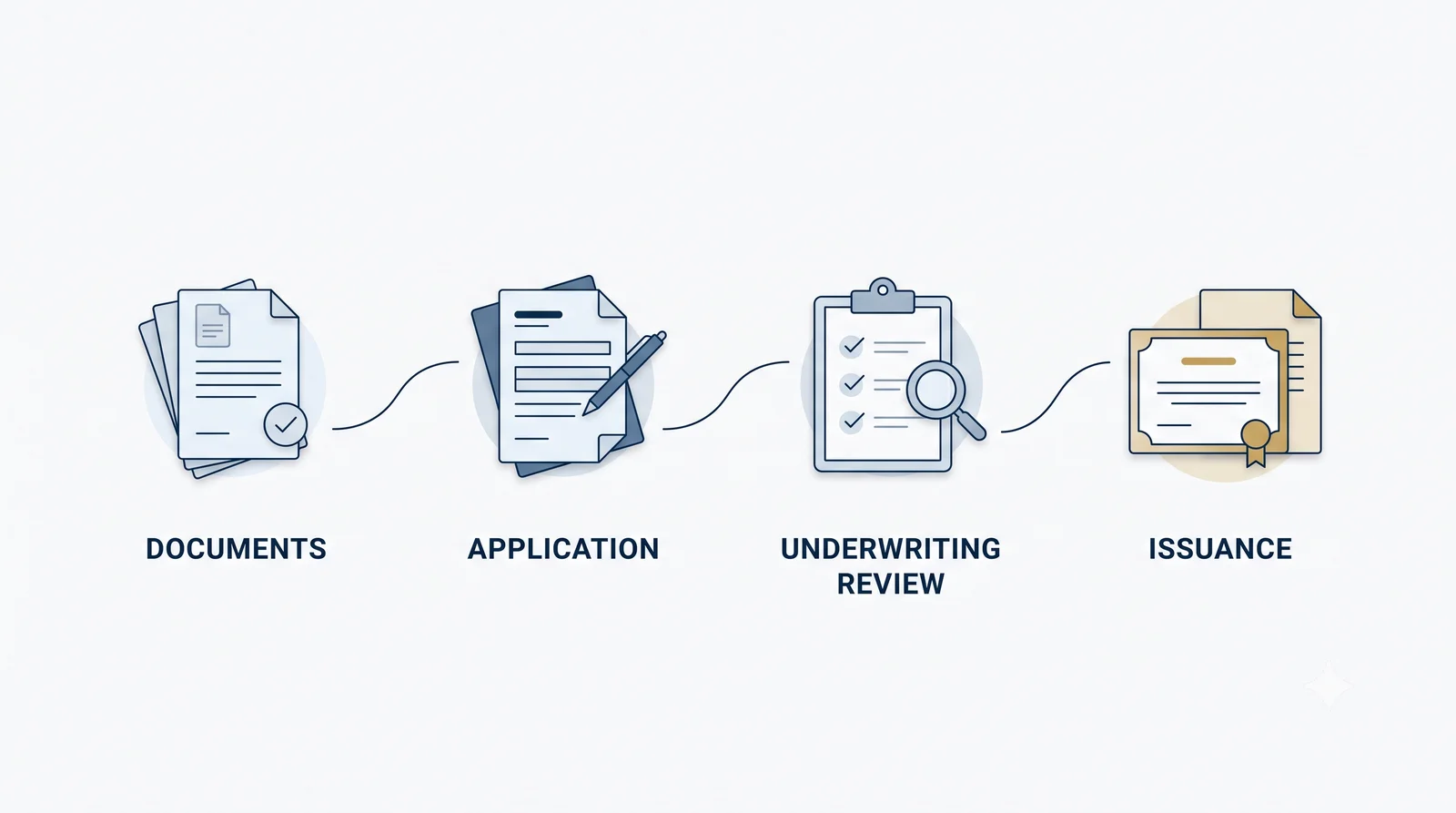
The Application Journey, Step by Step
Here's roughly how a typical application moves from requirement to issuance — say, for a mid-sized EPC contractor awarded a road-widening contract that calls for a Performance Bond:
- Read the tender clause carefully. The contract will specify the bond amount, format, beneficiary name and validity period — get any of these wrong at the outset and the bond has to be redone later.
- Bring in an IRDAI-licensed surety bond broker early — ideally before the Letter of Award if there's still a live bid. This is what lets us match the file to insurers with genuine appetite for that sector and bond size, rather than starting from scratch after award.
- Submit the application and supporting documents — for a Bid Bond: company profile, tender document, bank sanction letters, credit rating (if available), last 3 year financials, last 5 year project history, current and future orderbooks, CIBIL (if available) and bank utilization limit. For a Performance or Additional Performance Bond, the LOA is also needed apart from the above document list. For a Retention Bond, RA bills, RA bill summary and project milestones are also needed apart from the above documents.
- Go through underwriting. The insurer reviews net worth, order book and execution capacity, and may come back with clarifications — that's routine, not a red flag.
- Complete the required documentation and premium payment — once the terms are agreed, the required General Agreement of Indemnity (GAI), Board Resolution and premium are submitted/completed as required by the insurer for bond issuance.
- Bond issuance — the bond wording is checked word-for-word against the tender's prescribed format before the bond is executed and issued on a stamp paper at the preferred location of the contractor.
- Submit and monitor — submit within the tender deadline and track the bond's validity through project completion, and into the Defect Liability Period if the contract requires cover that far.
Documents You'll Need at the Application Stage
The exact list depends on whether you're applying for a Bid, Performance or Retention Bond — see the complete checklist by bond type, and downloadable Proposal Form on our Surety Bond Insurance page.
How Insurers Evaluate Your Application
Unlike a regular insurance policy, a surety bond isn't simply a risk that the insurer is pricing; it also involves credit being extended on your behalf. When they issue a bond, they're effectively vouching for you to the project owner and telling them "if this contractor fails, we'll pay." So before they say yes, they dig into your financials and track record much the way a bank would before sanctioning a loan.
In practice, here's what insurers actually look at when reviewing a file, though this list isn't exhaustive:
- Company type: Limited, Private Limited, LLP, Partnership, Proprietorship
- Net Worth
- Revenue
- Bond Type: Bid, Performance, Additional Performance, Retention, etc.
- Bond amount
- Type of Beneficiary
- Bond wordings
- Debt coverage ratio
- Relevant work experience
- Previous history of invocation of Bank Guarantees
- Banking Limits
- Bank Sanction Terms
- Kind of work undertaken (for example, mining is not preferred)
- Profitability
What Happens If a Bond Is Invoked?
A surety bond isn't free cover if something goes wrong — someone still bears the cost, and legally, that's you.
Under Section 126 of the Indian Contract Act, 1872, a guarantee involves three parties — Principal, Obligee and Surety. When an insurer issues a bond on your behalf, they're stepping into that guarantor role, and the General Agreement of Indemnity (GAI) is what makes you liable to reimburse them if a valid claim is ever paid out.
In practice: if the project owner invokes the bond and the insurer makes a payment, the insurer does not simply absorb that loss; recovery from the applicant may arise under the applicable indemnity arrangements. This is also why insurers evaluate applications the way they do — they're not just deciding whether to issue a bond, but whether you're a counterparty they could realistically recover from if something goes wrong.
How Long Does It Take?
On timelines: there's no fixed number, and anyone who promises one before seeing your documents is guessing. As a general pattern, straightforward applications with complete documentation are often turned around in a matter of days rather than weeks, while larger or higher-value bonds can take longer where deeper financial review, corporate due diligence, or reinsurer sign-off is involved. What genuinely moves the needle: how complete your documentation is and how quickly you respond to underwriting queries.
What Does It Cost?
Typically, premiums range from 0.5% p.a. to 4% p.a. or more, depending on your financial profile, project risk and bond tenure — genuinely case by case.
Is Collateral Required?
This is one of the questions we get asked most often. Surety bonds typically take cash margin as the only collateral — they do not accept property, shares, etc. Many insurers avoid taking any kind of collateral, but from case to case, collateral can range from 5% to 15% of the bond value as cash margin.
Common Reasons Applications Get Delayed — and How to Avoid Them
Most delays are avoidable with early planning:
- Applying in the final days before a deadline
- Incomplete or outdated financial statements
- Applying for the wrong bond type, or wording that doesn't match the tender
- Reinsurance requirements on very large bonds
- Slow responses to underwriting queries
Stamp Duty and Execution Formalities
Surety bonds are stamped legal instruments, and getting this formality wrong is a common — and entirely avoidable — reason bonds get rejected at submission. Stamp duty is payable under the relevant state's stamp act, and the amount depends on the state and the bond value; confirm the applicable duty with your insurer or broker before execution rather than assuming a flat rate. Your broker should be running the full execution checklist — wording match, signatory details, attestation — before a bond goes anywhere near submission.
What Happens After Bond Issuance
Receiving the bond isn't the finish line. Submit the original to the project owner as specified, keep copies with any acknowledgements, and track its validity against your project timeline — for many bonds, that means staying valid through project completion and into the Defect Liability Period, not just up to handover.
If your timeline shifts, request an extension well before the current bond expires. Once obligations are fulfilled, the beneficiary will typically issue a release confirming the bond is no longer required — worth chasing proactively rather than assuming it happens on its own.
Why Working With an Experienced Surety Bond Broker Helps
We're an IRDAI-licensed surety bond broker, and our role goes well beyond forwarding your documents to an insurer. We read your tender's bond clause the way an underwriter will, match your project to insurers with genuine appetite for that sector and size, and flag documentation gaps before they turn into delays. We also stay involved after issuance — if an extension or amendment comes up later, that's still our job. This coordination can help identify documentation gaps early and reduce avoidable delays during underwriting and issuance.