Key Takeaways
- A Surety Bond is a three-party guarantee — Principal (Contractor), Obligee (Project Owner) and Surety (Insurer) — that supports contract performance rather than compensating for accidental loss or damage.
- Surety Bond Insurance was introduced in India under the IRDAI (Surety Insurance Contracts) Guidelines, 2022, and can serve as a bank guarantee alternative where tender conditions permit.
- Only IRDAI-registered general insurers can issue a Surety Bond, and every application goes through underwriting based on financial strength, project experience and technical capability.
- Common bond types include Bid Bonds, Performance Bonds, Advance Payment Bonds and Retention Money Bonds, each used at a different stage of a project.
- A Surety Bond is not a universal replacement for a Bank Guarantee — suitability depends on the specific tender and the contractor's profile.
Introduction
For years, a Bank Guarantee was the only real answer here. It works, but it also ties up a contractor's non-fund-based banking limits and, depending on the bank's assessment, may require cash margin or collateral on top. For a business juggling two or three tenders at once, that adds up fast.
This is exactly why we're receiving more enquiries about Surety Bond Insurance—introduced in India under the IRDAI (Surety Insurance Contracts) Guidelines, 2022, and now being accepted by several government and private project owners as an alternative form of contractual security, wherever tender conditions permit.
We've put this guide together the way we'd explain it across the table to a client: what a surety bond actually is, when it's realistic to use one, and how it compares with a bank guarantee.
Surety Bond at a Glance
| What it is | A three-party guarantee where an insurer supports a contractor's obligations to a project owner |
| Who's involved | Principal (Contractor), Obligee (Project Owner), Surety (Insurer) |
| Common uses | Bid security, performance guarantees, advance payment protection, retention money |
| Who issues it | IRDAI-registered general insurers |
| Who helps arrange it | An IRDAI-licensed insurance broker, who coordinates documentation and insurer selection on your behalf |
| Does it replace a BG? | Only where the specific tender or contract permits it |
What Is a Surety Bond?
A surety bond is a contractual guarantee issued by an insurer that helps a contractor meet the security requirements of a tender or contract. It's also known as a bid, performance, retention or advance payment bond.
It isn't the same as a standard insurance policy—it won't pay out for fire, theft or machinery breakdown. Its whole purpose is to support contract performance. Every surety bond we arrange involves three parties:
- Principal
- Obligee
- Surety
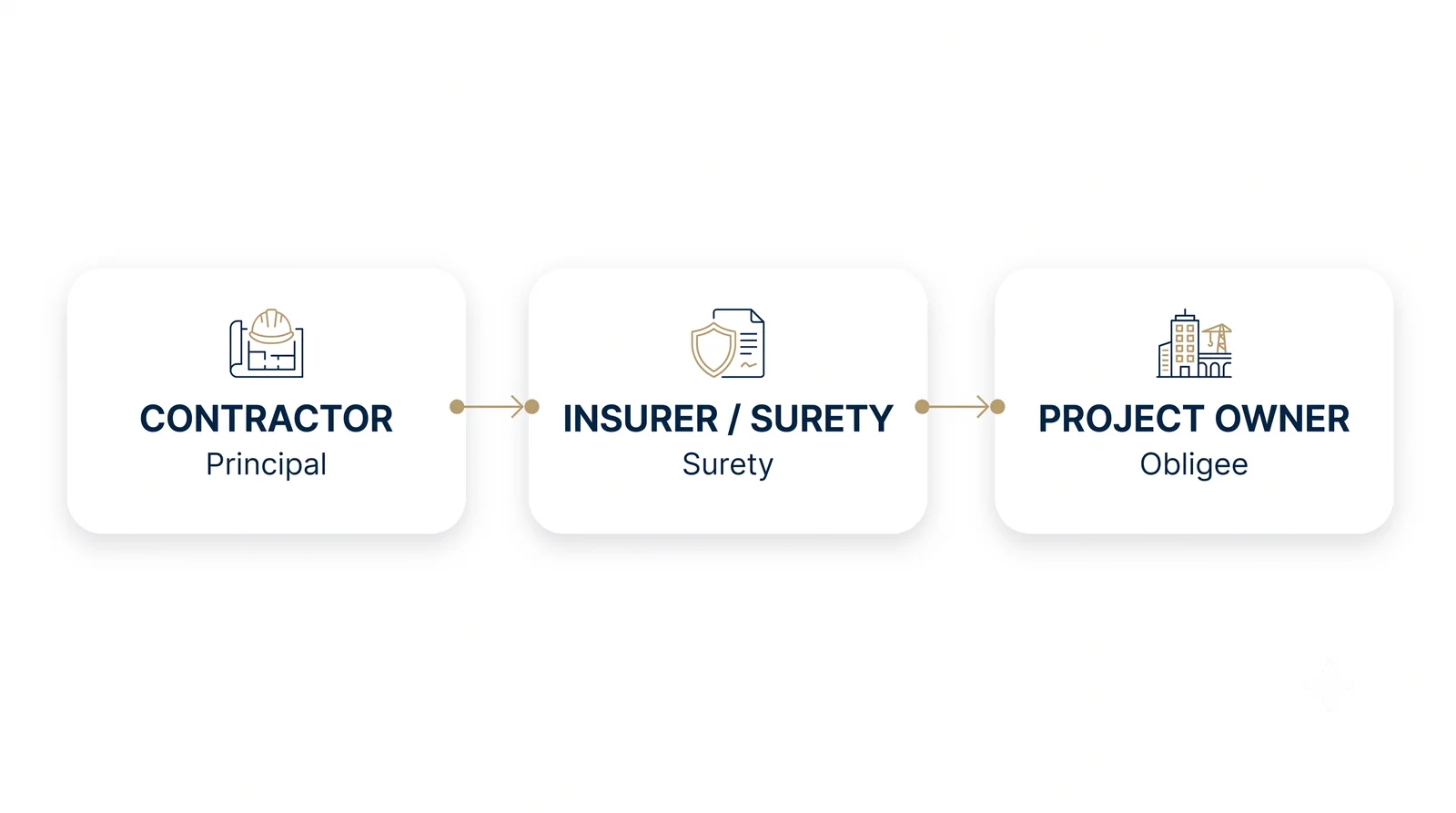
We've explained the three-party structure of a Surety Bond and exactly what each party is responsible for in more detail if you'd like to explore it further.
Why Do Project Owners Ask for One?
Project owners—particularly government authorities and public sector organisations—typically require a performance guarantee before awarding a contract. During the tender stage, this may be in the form of an Earnest Money Deposit (EMD), also referred to as Bid Security, while after the contract is awarded, they usually require a Performance Guarantee, also known as Performance Security.
These requirements help protect the project owner if the contractor fails to fulfil their contractual obligations.
Where the tender conditions permit, a Surety Bond can serve as a bank guarantee alternative – alongside other approved forms of security such as Fixed Deposits (FDs), Demand Drafts (DDs), or other approved forms of security, giving contractors additional flexibility in meeting contractual requirements.
How Does a Surety Bond Actually Work?
Here's the sequence we walk contractors through on almost every call:
- A tender or contract specifies that a surety bond is required as security.
- The contractor applies through a licensed insurance broker or directly with an insurer, submitting financial and project details.
- The insurer underwrites the application by reviewing the contractor's financial position, technical capability and project experience.
- If the application is approved, the insurer issues the bond in favour of the project owner.
- The contractor executes the project while the bond remains in force.
- If the contractor fails to meet the obligations covered under the bond, the project owner may make a claim, subject to the bond's terms and conditions.
Underwriting timelines vary depending on the insurer, the bond type and the complexity of the project. Starting the process early gives enough time to complete underwriting and, if required, arrange an alternative security such as a Bank Guarantee before the tender submission deadline.
Our Surety Bond application process explains the complete application process and documentation in greater detail.
Where Is a Surety Bond Actually Required?
We're seeing surety bonds come up most often in:
- State and Central Government tenders and public procurement
- National and state infrastructure projects—highways, bridges, metro and railway work
- EPC (Engineering, Procurement and Construction) contracts
- Renewable energy and power projects
- Industrial and manufacturing contracts
- Municipality works
- Large private construction and commercial developments
Different bond types are required at different stages of a project:
- Bid Bonds during tender submission
- Performance Bonds after the contract is awarded
- Advance Payment Bonds when mobilisation advances are released
- Retention Money Bonds in place of amounts otherwise retained by the project owner
We always encourage contractors to begin the process as early as possible. This provides sufficient time for underwriting and ensures that, if a surety bond cannot be issued for any reason, there is still adequate time to arrange an alternative such as a Bank Guarantee, Fixed Deposit or Demand Draft without putting the tender deadline at risk.
The Common Types of Surety Bonds in India
Bid Bond
Submitted with a tender bid, it assures the project owner that the bidder will honour the bid and sign the contract if awarded. In some tenders, it may be accepted instead of an Earnest Money Deposit (EMD).
Performance Bond
The bond we arrange most frequently. It backs the contractor's commitment to complete the work as per the contract and generally remains valid throughout the contract period.
Advance Payment Bond
Covers mobilisation or advance funds released upfront, protecting the project owner if those funds are not used for the agreed purpose.
Retention Money Bond (Retention Bond)
May be accepted instead of retaining a portion of the contractor's payments, subject to the terms of the contract.
Surety Bond vs Bank Guarantee
Contractors almost always ask us this straight up:
"Isn't this just a Bank Guarantee with a different name?"
It isn't.
While both serve as financial security for the project owner, they're issued by different institutions and assessed using different underwriting approaches — with different implications for your banking limits and collateral.
For the full feature-by-feature comparison — issuer, banking-limit impact, collateral and regulatory framework see the table our Surety Bond vs Bank Guarantee: Which Is Better for Contractors in India? blog which breaks down the working capital impact, claims handling and real cost side of that decision.
Documents You'll Typically Need
Requirements vary by insurer and bond type — see the full Surety Bond document checklist and application guide in our detailed guide on how to get a Surety Bond in India.
Why Work With CKP Insurance Brokers
As an IRDAI-licensed insurance Broker specialising in Surety Bonds, we spend most of our time helping contractors determine whether a surety bond is the right fit for their project, presenting applications to insurers and matching clients with insurers that understand their industry.
Every tender comes with its own quirks, so our process starts with understanding your specific project and financial position before we approach insurers on your behalf — our objective is to help you complete underwriting efficiently and get the bond issued in time for submission wherever the contract requires it.
We also support many of the same clients with related project risk solutions, including Contractors All Risk (CAR) Insurance, helping businesses protect both their contractual obligations and broader project risks.
Our experience in Surety:
- Karnataka Power Transmission Co. Ltd. (KPTCL)
- Jaipur State Transport Co. Ltd. (JSTCL)
- Brahmos (ministry of defence) (DRDO)
- Convergence Energy Services Limited (CESL)
- Karnataka Industrial Areas Development Board (KIADB)
- Pune Metro
- Nagpur Metro
- NHAI
- BHEL
- Maha Rail
- Thane Metro
- MMRDA
- Western Central Railway
- IRCON
- RVNL
- JNPT
The Bottom Line
Surety Bonds are not a universal replacement for Bank Guarantees, and they won't be suitable for every contractor or every tender.
However, for many contractors, EPC companies and infrastructure businesses, they provide an effective alternative that can help preserve valuable banking limits and improve working capital flexibility—allowing more funds to remain available for executing projects rather than being tied up with a bank.
If your next tender requires a financial guarantee, it's worth exploring whether a Surety Bond is an option before deciding on a Bank Guarantee.