
You've just won the project or want to apply for a new government tender. The Letter of Acceptance is in hand or you are about to fill in your L1 Bid, and now the project owner wants Performance Security before the agreement is signed — typically 3% to 10% of the contract value — or wants EMD, depending on whether it's a works or goods contract and the specific tender's own clause. Your bank suggests a Bank Guarantee, as it has for years. Then someone in the pre-bid meeting mentions a Surety Bond/Insurance Security Bond instead, saying it won't touch your bank limits.
For most contractors juggling more than one live project, a Surety Bond is usually the better fit — it frees up capital a Bank Guarantee would otherwise lock away. But "usually" isn't "always," and there are real situations where a BG still makes more sense. Let's get into exactly why, and where each one wins.
Why Surety Bonds Often Have the Edge
- Keeps your bank's Non Fund Banking limits available for future tenders instead of using them on the current project.
- Reduces pressure on working capital, as cash margin requirements are often lower than a comparable Bank Guarantee.
- May lower the effective financing cost, because you're not tying up funds that could be used elsewhere in the business.
- Can take less than 2 working days to sanction the amount and issue a bond, while a bank non-fund-based sanction along with issuance takes at least 7 days or more.
These advantages explain why many contractors now evaluate a Surety Bond before defaulting to a Bank Guarantee. However, the right choice still depends on the tender conditions, project requirements, and your financing position.
Why Contractors Compare the Two
Both instruments exist for the same reason — to reassure the project owner that you'll deliver. That's where the similarity ends. A Bank Guarantee is a banking product that sits on your Non-Fund Based (NFB) limits. A Surety Bond is an insurance product, underwritten by an IRDAI-registered insurer.
Following the Ministry of Finance's 2022 amendment to the General Financial Rules, Insurance Surety Bonds are now accepted as an eligible alternative to Bank Guarantees for government procurement. As more contractors — EPC firms, road builders, infrastructure companies — hear about Surety Bonds, the real question isn't which one is "better" in the abstract. It's which one fits this tender, this project, this stage of your business.
New to Surety Bonds? Surety Bonds Explained covers the basics — here, we're focused purely on which one to actually pick.
Which One Fits Right Now? Quick Guide
If you've decided a Surety Bond may be suitable, see our How to Get a Surety Bond in India guide for the application process, documents and underwriting steps.
Choose a Surety Bond if:
A Bank Guarantee still makes sense if:
Working Capital & Non Fund Banking Limits — The Difference Most Contractors Notice First
This is usually the first thing that catches a contractor's attention. Every Bank Guarantee eats into your sanctioned NFB limit. If your bank has sanctioned, say, ₹10 crore in NFB limits, and two ongoing projects have already used ₹8 crore of that in guarantees, you're left with very little room for the next tender even if you're fully capable of executing it.
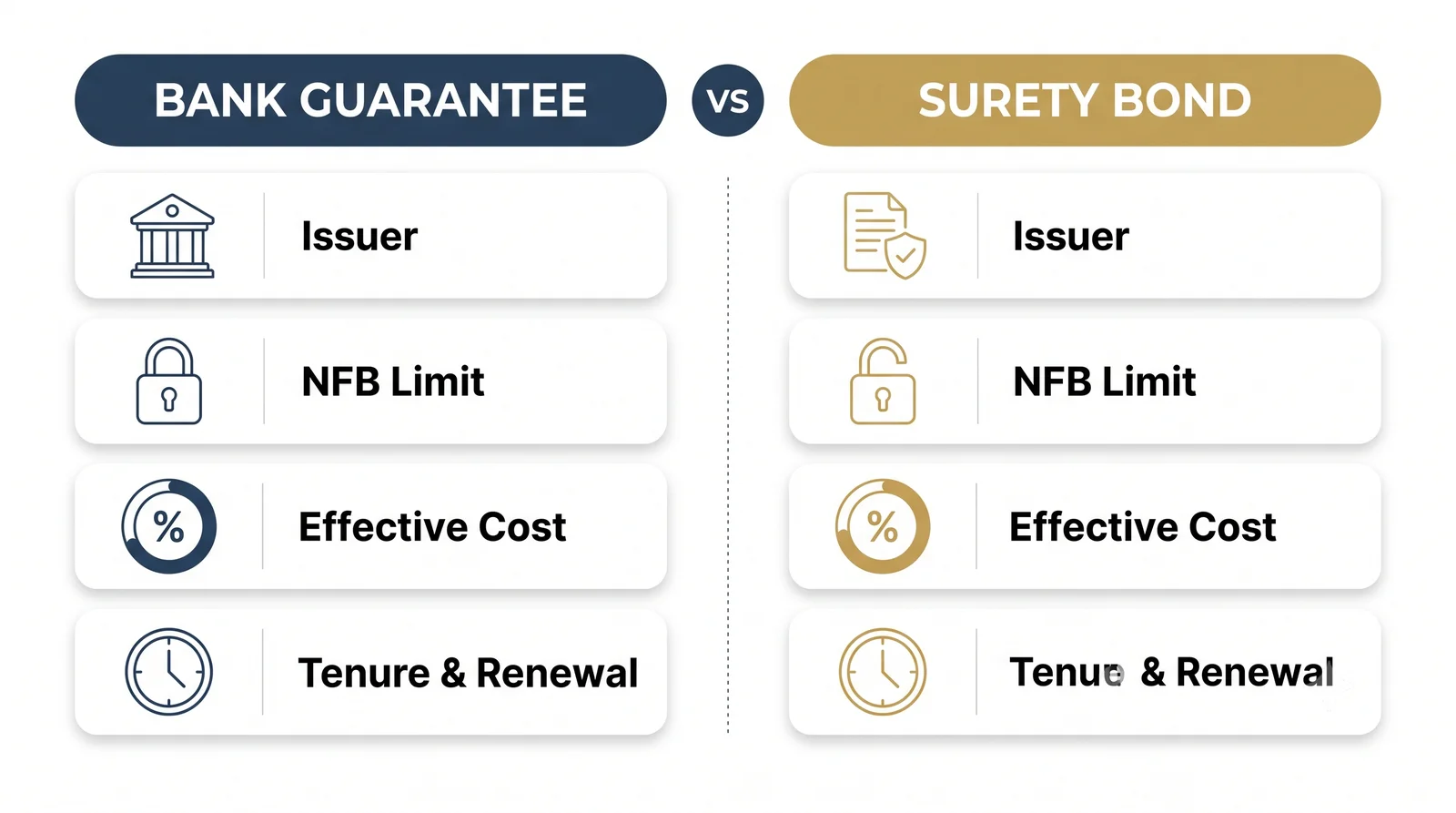
The true cost of a Bank Guarantee isn't just the bank commission; it's the working capital it locks up. On a ₹50 crore contract with a 5% performance security requirement, the obligation is ₹2.5 crore. If your bank asks for, say, a 50% cash margin on that exposure — not unusual for a large obligation — that's ₹1.25 crore of your liquid capital frozen for the multi-year duration of the contract. A Surety Bond, issued by an insurer rather than your bank, generally sits outside this NFB calculation and typically requires a smaller cash margin in comparison.
Want to see the comparison in one place? View our Surety Bond vs Bank Guarantee comparison on the Surety Bond page.
Claims & Invocation — The Biggest Practical Difference
Most Bank Guarantees in India are structured to be invoked on demand — the project owner presents a claim as per the guarantee wording, and the bank pays first, recovers from you later, without examining whether the default actually happened as claimed. That's a real exposure for a contractor: it means a guarantee can be encashed on a disputed claim before you've had any chance to contest it.
Collateral, GAI & Contractor Responsibility
A Surety Bond reducing your cash margin doesn't mean it's removing your liability. Before issuance, the insurer will ask you — and often your promoters — to sign a General Agreement of Indemnity (GAI), making you liable to reimburse them in full if a valid claim is ever paid, and in many cases your directors personally too, as we explain in What Happens If a Bond Is Invoked. The bond simply changes who pays the project owner first — it doesn't take you out of the equation.
What Affects the Overall Cost?
There's no fixed rate card for either instrument — every quote is built around your specific profile, project risk, and bond type, so treat any number you hear before underwriting as indicative. Premiums generally range from 0.5% p.a. to 4% p.a. or more for a Surety Bond, and BG commissions typically run 0.75% to 2% p.a. On the sticker price alone, a BG usually looks cheaper.
That comparison is incomplete, and it's where most contractors stop too early. A BG's real cost isn't its commission; it's what the locked-up cash margin could have earned or been used for elsewhere. Money sitting as margin against a bank guarantee isn't idle by choice; it's capital you can't deploy toward the next bid, new equipment, or even an FD return. Once you price in that opportunity cost, the effective cost of a BG is often higher than its commission suggests — and for a contractor running multiple live projects, that's the number that actually matters, not the headline rate.
Common Myths
Myth: Surety Bonds are always cheaper.
Fact: Not on premium alone — BG commissions are usually lower. The real saving comes from avoiding the BG's locked-margin cost.
Myth: A Surety Bond replaces every Bank Guarantee.
Fact: Only where the tender permits it — many still require a BG.
Myth: Surety Bonds need no collateral, so there's no responsibility.
Fact: Most still take a 5%–15% cash margin, and the GAI keeps you fully liable regardless.
Myth: Surety Bonds are only for large companies.
Fact: MSMEs qualify too, based on track record, not size.
Which Option Is Right for Your Business?
Before you decide, ask yourself:
- Does the tender document explicitly permit Surety Bonds?
- Do I need to keep NFB limits free for other bids?
- Is working capital tight because of multiple live contracts?
- Does the project owner prefer speed of claim settlement, or a more examined process?
- Are my existing BG terms with the bank already competitive and easy to draw on?
For most contractors juggling live projects, these answers point toward a Surety Bond. But if the tender mandates a BG, or it's a one-off project with comfortable bank limits, don't force the alternative just because it's newer — go with what actually fits.
When a Bank Guarantee May Still Be the Better Choice
Some tenders still call for a Bank Guarantee specifically, with no mention of Surety Bonds as an alternative — in that case, the decision is already made for you. While central government bodies and PSUs actively accept surety bonds under the GFR amendment, several state-level Public Works Departments and municipalities are still in the process of updating their own bidding manuals to reflect it — worth confirming for your specific authority rather than assuming.
Conclusion
The better option isn't determined by the instrument itself — it's determined by your tender conditions, available bank limits, working capital position, and project requirements. That said, if you're managing more than one live project and the tender gives you a choice, a Surety Bond is usually the stronger move — it's rarely the wrong call to at least check.