Quick answer
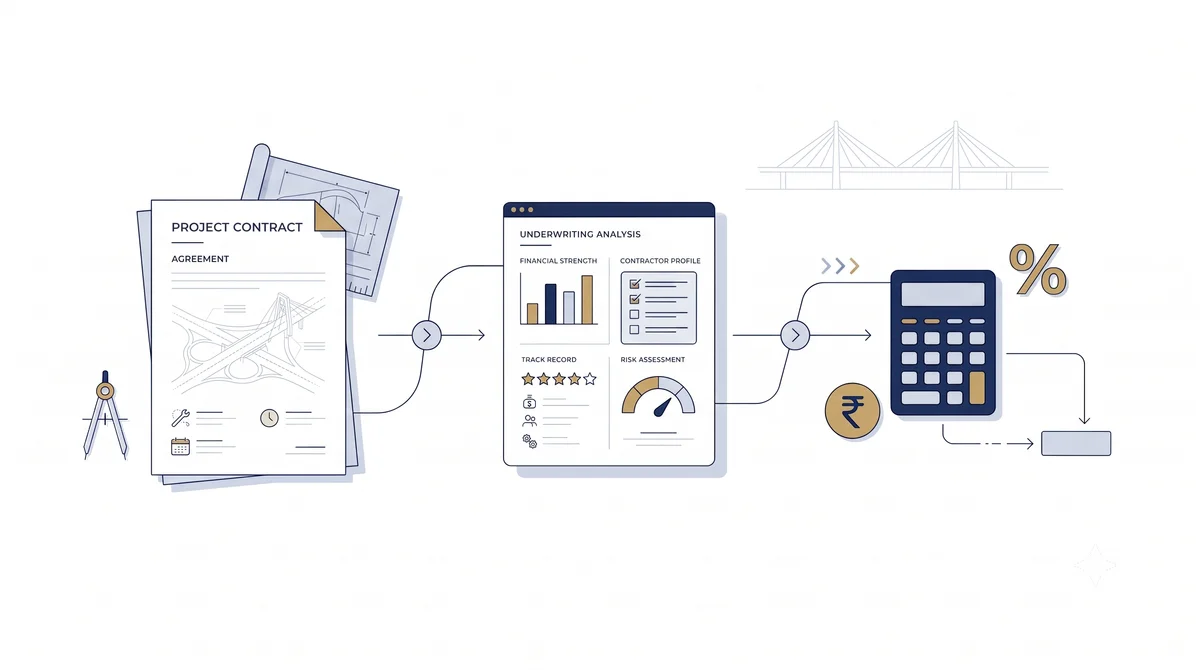
There's no fixed rate card for a Surety Bond in India — every premium is underwritten individually, directionally in the 0.5% p.a. to 4% p.a. or more range, plus 18% GST on the premium. What actually moves you within that range, and what your real cash outflow looks like once GST and any cash margin are added in, is what this guide walks through.
"How much does a Surety Bond actually cost?" is usually the first question contractors ask. What's more useful than repeating that range is showing you how an insurer actually arrives at a number, what your real outflow looks like once GST and cash margin enter the picture, and how to tell two quotations apart instead of just eyeballing which one looks cheaper.
What Insurers Are Actually Weighing
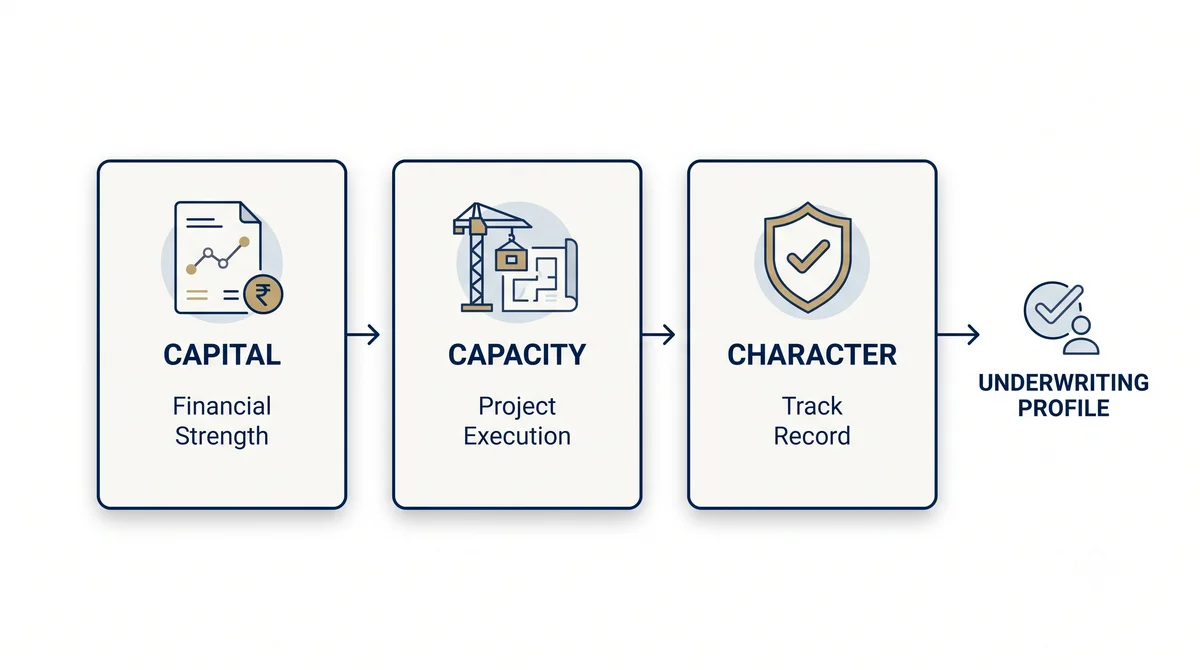
When we sit across the table with a contractor, we usually break down what an insurer is assessing into three buckets — not an official industry term, just how we find it easiest to explain.
- Capital: your balance sheet, liquidity and net worth relative to the work you're taking on. For MSMEs especially, clean and timely audited statements often carry as much weight as the turnover number itself.
- Capacity: your delivery history at similar scale, your order book against your resources, and the bond amount and duration you're asking for. Unfamiliar scale or sector reads as more risk, whatever the balance sheet says.
- Character: whether you've had a bond invoked before, and your general track record on contracts. A clean record here is one of the strongest things you can bring to the table.
What This Looks Like on a File
Percentages are easier to reason about with real numbers. Take a mid-sized EPC contractor who's been asked for a ₹1 crore Performance Bond running for 24 months. Say the insurer quotes 1.5% p.a. after underwriting — illustrative only, your own number will depend on your file:
- Premium: 1.5% p.a. × ₹1,00,00,000 × 2 years ≈ ₹3,00,000
- GST at 18%: ₹54,000
- Total premium outflow: ≈ ₹3,54,000
If a cash margin is also asked for — say 10% of the bond value — that's a further ₹10,00,000 held as FD, and interest is earned on it, not spent as a cost. It's refundable on closure, but it sits out of circulation for the life of the bond, so it's worth asking about upfront. Premium and FD liquidity are your real cost.
Comparing Two Quotes? Look Past the Percentage
We regularly see contractors compare quotes purely on the headline number and assume the lower one wins. It often doesn't, once you check what's attached to it:
- Is a cash margin attached, and how much — a lower premium with a heavier margin can cost more in locked-up capital than a higher one with none.
- Is GST already reflected in the quoted number, or added separately?
- What's the documentation and turnaround commitment behind it — a cheaper premium isn't worth much with a slower issuance timeline.
Getting Better Pricing Over Time
Better pricing isn't negotiated into a single application — it's extended once an insurer has seen enough of your track record. A few things that genuinely move the needle:
- A consistent execution record at similar scale, delivered on time.
- Clean, current financials and consistent statutory compliance.
- Staying invocation-free — one of the single biggest levers on future pricing.
- Working with a broker who can present your file well and place it with insurers who genuinely have appetite for your sector.
If you're earlier in the process and want the full documentation and application walkthrough, that's covered in How to Get a Surety Bond in India.
Premium is only one part of the bigger financial decision — we've gone into how a Surety Bond's total cost stacks up against a Bank Guarantee's locked-up margin in Surety Bond vs Bank Guarantee: Which Is Better for Contractors in India, worth a read if you're weighing the two for an upcoming tender.
The Bottom Line
There's no shortcut to a fixed number, and it's worth being cautious of anyone who quotes one before seeing your file. What you can control is how prepared you walk in — clean documentation, a realistic ask, and an understanding of what's actually driving the number. That's usually the difference between a quote that surprises you and one that doesn't.